When should a company migrate a legacy backend to Java Spring Boot?

A practical way to decide whether a legacy backend is worth moving to Spring Boot, with the signals, trade-offs, and migration path that actually matter.
José Miguel Fernández · Software Engineer · 6+ years of experienceIn this article Current section: The short answer
Migrating a legacy backend to Spring Boot sounds neat until you look at the real system. There is usually history in there: shortcuts nobody documented, assumptions buried in production behavior, and a few critical flows that nobody wants to touch because “it still works”. That is worth remembering before selling the migration as a code-only job. It is also about risk, time, and how much pain the company is already carrying.
The short answer
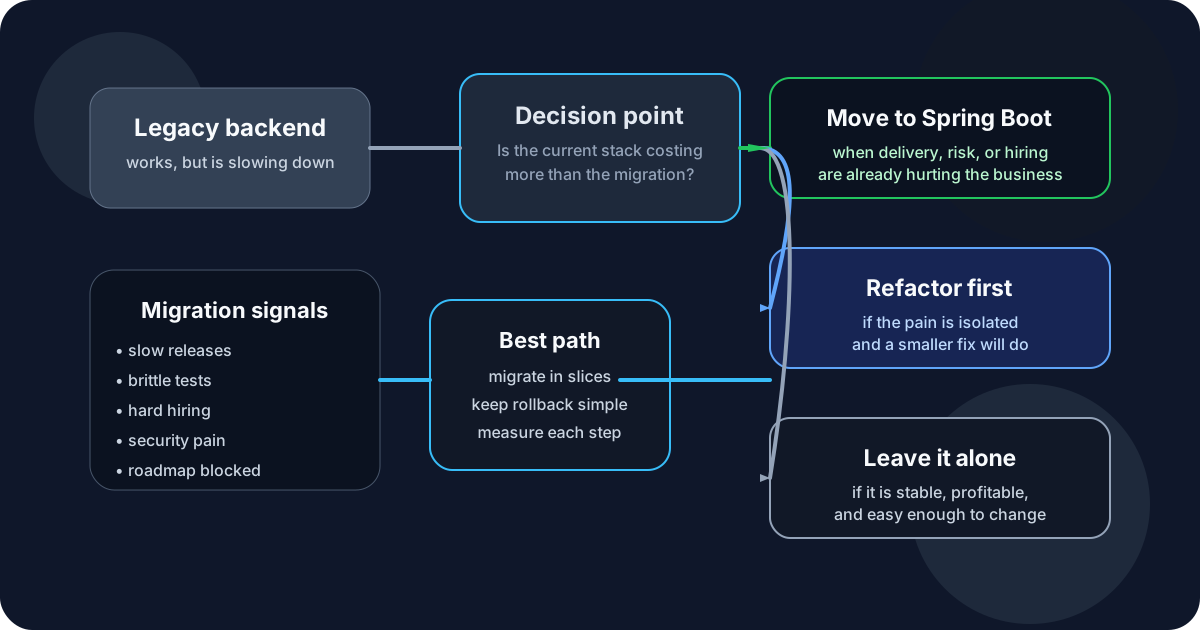
A company should migrate a legacy backend to Spring Boot when the current stack is slowing delivery, increasing operational risk, or making the team hard to scale, and when Spring Boot gives a lower-cost path for the next few years. If the system is old but stable, and the team can still ship safely, do not rewrite it just to feel modern.
Practical rule: migrate when the current backend is costing you more in lost speed, risk, and hiring friction than the migration will cost you in time.
The signals show up before the architecture does
You do not need a perfect diagram to notice the pressure. The signs show up in day-to-day work:
- releases are slow or fragile
- new engineers need too long just to understand the baseline
- tests are thin, flaky, or missing entirely
- security updates are painful or delayed
- the roadmap needs cleaner boundaries than the old system can provide
- every change seems to touch unrelated code
If the backend is still technically alive but every change feels like surgery, the system is already telling you something.
Good reasons to migrate
1. The legacy stack is expensive to maintain
Some backends are not broken, they are just expensive. A bug takes hours because nobody trusts the surrounding code. Deployments need manual steps. The few people who understand the system become bottlenecks. At that point, the real cost is not infrastructure. It is engineering time.
Spring Boot helps here because it gives the team a more standard structure, a huge ecosystem, and conventions that reduce the amount of custom glue you need to keep in your head.
2. Technical debt is blocking product work
When technical debt starts slowing feature delivery, it stops being a pure engineering concern. It becomes a product issue.
If every new feature needs workarounds, if regressions keep coming back, or if the codebase is full of brittle areas nobody wants to touch, migration can pay for itself by giving the team a cleaner path forward.
3. Hiring and onboarding are getting harder
This one gets ignored too often. Spring Boot has a very large developer pool, which matters if you want to hire faster or onboard new people without a two-month apprenticeship in internal folklore.
If backend hiring is slow because the stack is niche, old, or badly documented, moving to Spring Boot can make the team easier to grow.
4. Security and support are becoming a real problem
Old frameworks eventually turn into a maintenance tax. Missing patches, unsupported libraries, and dated dependencies can turn every release into a quiet risk review.
If the legacy backend makes security updates hard, migration is often a defensible investment. Not glamorous. Just necessary.
5. You need a cleaner base for growth
If the company is moving toward clearer module boundaries, more services, better observability, or stronger automation, Spring Boot gives you a much more mature default environment than many legacy stacks.
It is not magic, but it does make it easier to build a serious backend without inventing everything yourself.
Good reasons not to migrate yet
A lot of teams migrate too early. That mistake gets expensive quickly.
Do not migrate just because:
- the system is old
- Spring Boot is popular
- another company uses it
- the team wants a rewrite
- the architecture looks messy on a slide
If the system is stable, profitable, and still easy enough to change, a migration can introduce more risk than value.
And if the real problem is bad domain design, weak ownership, or a broken delivery process, Spring Boot will not fix that. It will only give you a nicer framework on top of the same operating model.
A decision framework that is actually useful
Before you move anything, answer these questions in order:
-
What is failing today? Be specific. Is it deployment, testing, security, hiring, performance, or roadmap speed?
-
Can we reduce the pain without a full migration? Sometimes refactoring, modularization, or an adapter layer is enough.
-
What business value would the migration create? Faster delivery, lower maintenance cost, lower risk, better hiring, or all of the above?
-
Can we migrate incrementally? If the answer is yes, the project is much easier to justify.
-
Who owns rollback if something breaks? If nobody can answer that clearly, the scope is too fuzzy.
If you cannot answer these questions, you probably do not understand the migration well enough yet.
The safest migration shape is usually incremental
For most companies, the right approach is not a big-bang rewrite. It is a gradual cutover.
That often looks like this:
- build new services or modules in Spring Boot while the legacy backend stays live
- move low-risk or read-only flows first
- extract high-change areas before touching the stable core
- put an adapter or anti-corruption layer between old and new code
- keep business-critical paths unchanged until the new stack proves itself
- measure every step so the migration does not become a guessing game
This is slower than a dramatic rewrite pitch, but it is often the difference between a controlled project and an expensive restart.
What Spring Boot solves, and what it does not
Spring Boot solves a lot of boring problems that legacy systems tend to make painful:
- dependency management
- sensible defaults
- testing support
- application observability with Actuator
- a large ecosystem for security, data access, messaging, and integration
- easier hiring because more engineers already know the stack
What it does not solve:
- poor domain modelling
- unclear product priorities
- missing ownership
- weak tests
- bad rollout discipline
If the company is messy, Spring Boot will not clean it up for you. It will just make the mess easier to run.
A simple way to think about the decision
Migrate when the current backend is blocking the company more than the migration itself would.
In practice, it tends to mean one or more of these is true:
- release velocity is falling
- engineering cost is rising
- security risk is increasing
- hiring is getting harder
- the current stack cannot support the roadmap
- every change keeps widening the blast radius
If none of those are true, the migration is probably optional. Maybe even premature.
My practical take
The best time to migrate is not when the old backend is fashionable to replace. It is when it is becoming expensive to keep alive.
That does not mean you should panic and rewrite everything. It means you should be honest about where the cost sits. If the team is already spending too much time fighting the stack, Spring Boot can be a good reset. If the backend is still serving the business well, leave it alone and keep shipping.
And if you do migrate, do it in slices. The last thing you want is a heroic rewrite that turns into a year-long detour.
If you want the next step after the migration decision, the operational side matters too. I would continue with Spring Boot in production: a DevOps checklist and Spring Boot performance tuning.
Bottom line
A company should migrate a legacy backend to Java Spring Boot when the current system is slowing delivery, increasing risk, or making the team harder to scale, and when Spring Boot offers a clearer and cheaper long-term path.
It is not a fashion move. It is a cost, risk, and delivery trade-off.
If you need to ground a migration or incremental backend evolution, a focused Spring Boot backend intervention can fit.
If the backend is still healthy enough to support the business, do not touch it just because it looks old. If it is getting in the way, migration starts making sense.
FAQ
Should every legacy backend move to Spring Boot?
No. Some systems are old but still a good fit for the business. Age alone is not a reason.
Can Spring Boot hide bad architecture?
Yes. It can make a poorly managed system easier to work with, but it will not fix the underlying design problems.
Is incremental migration safer than a rewrite?
Usually yes. Smaller cuts reduce risk, make rollback possible, and let the team learn as it goes.
What if the backend is stable and profitable?
Leave it alone unless you have a clear business reason to change it.
Sources and verification notes
- Spring Boot reference documentation: https://docs.spring.io/spring-boot/reference/
- Spring Boot production-ready features / Actuator: https://docs.spring.io/spring-boot/reference/actuator/index.html
- Spring Boot data access and SQL: https://docs.spring.io/spring-boot/reference/data/sql.html
- Spring Boot security reference: https://docs.spring.io/spring-boot/reference/web/spring-security.html
- Spring Boot testing reference: https://docs.spring.io/spring-boot/reference/testing/index.html
- Upgrading Spring Boot: https://docs.spring.io/spring-boot/upgrading.html
Decision and next step
Would you like to apply this decision to your case?
I can help you review the context, reduce the initial scope and choose a solution proportionate to the problem.