Legacy backend modernization: cost, risks and phases
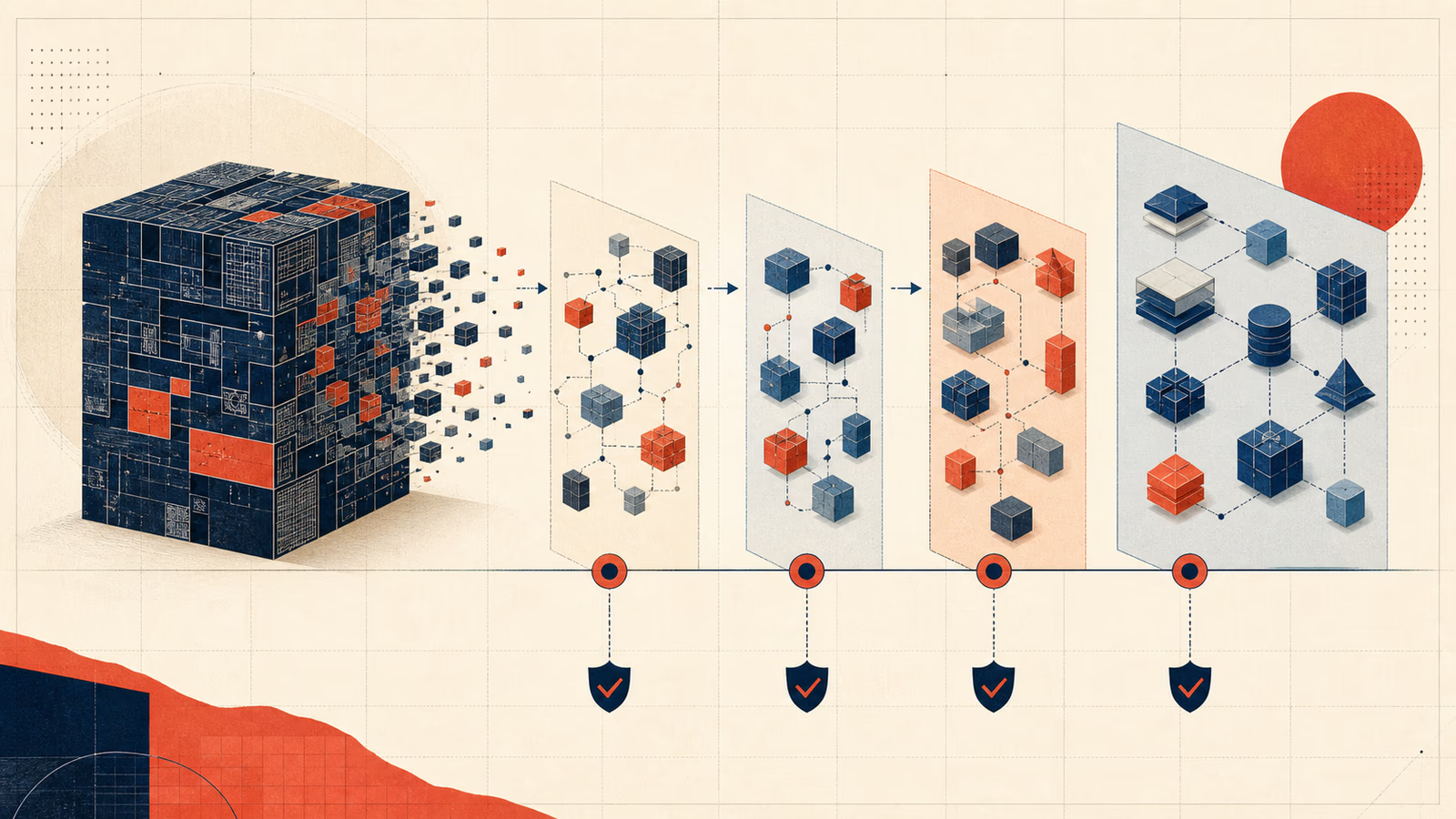
Plan legacy backend modernization through diagnosis, tests, boundaries, coexistence, rollback and exit criteria.
José Miguel Fernández · Software Engineer · 6+ years of experienceIn this article Current section: 1. What modernization means—and what it does not
Modernizing a legacy backend is not replacing one framework with another. It is reducing the cost, risk, or delay that prevents the product from progressing while preserving behaviour that supports the business. Technology is a tool within that transition, not the final outcome.
This distinction prevents two expensive mistakes: starting an open-ended rewrite whose benefits remain distant, or merely updating versions without removing the constraint. A useful programme states the expected improvement—fewer incidents, more frequent releases, a supported platform, or retired manual work—and divides delivery so it can demonstrate that improvement early. Cost, risk, and phases must be considered together.
1. What modernization means—and what it does not
Modernization can include upgrading runtimes and dependencies, modularising a monolith, adding tests, automating delivery, separating a capability, or replacing an integration. It does not require microservices or cloud infrastructure. If a modular monolith meets the objectives with less operational burden, it is modern for that context.
Express the problem with a baseline. “Price changes take four weeks and 20% need correction” is actionable; “the code is old” is not. Add regulatory constraints, maintenance windows, seasonal peaks, budget, and available skills. Define behaviour that must not change.
A backend, API, and architecture audit can turn symptoms into prioritised risks before a broad commitment. The guide to what to review before rewriting describes the evidence needed to compare paths.
2. The components of real cost
New implementation is only one part. Budget for behaviour discovery, characterisation tests, design, development, data cleaning and migration, contract compatibility, observability, temporary infrastructure, security, documentation, training, and retirement. Include domain experts who clarify rules and validate results.
Add dual operation. Two components, pipelines, or data models may coexist for weeks or months. Both need monitoring, reconciliation, and urgent fixes. Opportunity cost matters too: which features are delayed, and how much time does the transition take from scarce specialists?
Use a range by phase with explicit assumptions rather than one number. Separate committed cost from optional cost and hold contingency for data and integrations, where uncertainty often appears. A professional estimate explains which evidence would narrow its range.
3. Risks that change a modernization most
The first risk is hidden rules in code, procedures, files, and manual work. The second is unknown consumers of APIs, events, or tables. The third is data quality: duplicates, invalid values, and broken references turn an apparently simple copy into a business decision project.
Changing language, architecture, data model, infrastructure provider, and team at the same time also increases risk. Each dimension adds hypotheses and makes failures harder to explain. Reduce variables: retain contracts temporarily, migrate one boundary, and choose technology the team can operate.
Other risks include unrepresentative performance tests, weakened security during coexistence, missing rollback, and exhaustion of a team maintaining production while building the destination. Record probability, impact, early signal, mitigation, and owner. Review these at each milestone instead of leaving a matrix untouched after kickoff.
4. Phase 0: diagnosis and investment decision
Map modules, data, integrations, deployment, and critical journeys. Review incidents and a sample of changes to find where time goes. Identify platform support and security exposure. OWASP’s Application Security Verification Standard provides a reference for testable application controls.
Define success measures and alternatives. Upgrading Spring Boot, improving the pipeline, or encapsulating a supplier may solve much of the problem without extensive migration. If modernization remains best, choose a first boundary that is valuable, observable, and reversible.
The exit condition is not “analysis completed.” There should be a sufficient inventory, critical risks, economic range, owners, and approval for an initial block. Turn unresolved questions into experiments instead of silent assumptions.
5. Phase 1: build a safety net
Before moving logic, protect journeys that cannot break. Add characterisation tests, API and event contract tests, and a small set of end-to-end cases. Do not pursue uniform coverage: prioritise money, permissions, regulated data, and irreversible operations.
Establish shared observability. Correlation IDs, business measures, traces, and structured logs allow comparison of old and new. Configure dashboards and alerts before routing traffic; otherwise, the first user becomes the monitoring system.
Automate reproducible builds, controls, and deployments. Verify backup, restore, and rollback through a rehearsal. DORA’s official metrics guide helps measure whether delivery capability actually improves. This phase ends when the team can detect, diagnose, and reverse a failure at the selected boundary.
6. Phase 2: define the boundary and coexistence
Choose a capability with an identifiable contract and manageable dependencies, not necessarily the easiest module. Define inputs, outputs, data ownership, and error behaviour. If code is tightly coupled, introduce a facade or port inside the monolith first. Hexagonal architecture can isolate domain logic without requiring distribution.
Design coexistence explicitly: routing by customer, feature, or percentage; backwards compatibility; deployment order; synchronisation; and duration. Avoid naive dual writes because partial failure leaves sources divergent. Prefer one owner for each datum and propagate changes through observable mechanisms with reconciliation and idempotency.
Define rollback before migration. State who decides, what signal triggers it, how traffic returns, and what happens to data created while the destination was active. A feature switch without a data strategy is not complete rollback.
7. Phase 3: migrate the first vertical slice
Implement one small journey end to end: contract, logic, persistence, observability, and deployment. Avoid spending months on a generic platform with no user. The first slice should test the riskiest hypotheses and produce an outcome the business can validate.
Move gradually: internal traffic, one controlled group, then larger percentages. Compare latency, errors, business outcomes, and data. Shadow execution can help where safe, but operations with effects cannot be repeated without protection. The guide to idempotent APIs covers retry and duplicate handling.
Record actual effort. If every rule uncovers three manual processes, update the range before the next cut. Exit combines functional equivalence, stability for an agreed period, operational readiness, and measured benefit.
8. Phase 4: expand by slices and retire the old
After the pilot, prioritise boundaries by value, risk, and reusable learning. Keep batches small and make a continue, adapt, or stop decision after each. Every slice includes migration and retirement; adding only the new side makes infrastructure, contracts, and cognitive load grow indefinitely.
Retirement needs evidence: zero traffic for an agreed period, confirmed consumers, data archived according to retention, jobs disabled, access removed, and runbooks updated. Preserve records required for audit, not running servers “just in case.” Give each residual item an owner and date.
Revisit architecture and costs every few cuts. Learning may justify keeping part of the monolith or changing order. Martin Fowler’s Strangler Fig Application describes progressive replacement; its strength is enabling successive decisions, not promising that everything ends as distributed services.
9. Governance, team, and ownership
Modernization needs an owner for the business outcome and one for technical coherence, plus operations, security, and domain experts. People who understand the legacy should not become a support desk without decision power. Reserve their time and capture knowledge as examples, tests, and documentation near the code.
Using a supplier does not remove internal ownership. The company should control repositories, infrastructure, credentials, architecture decisions, and acceptance criteria. Request executable deliverables and continuous transfer rather than a document handover at the end.
A compact governance view can show baseline and current measures, primary risk, consumed cost, next boundary, and pending decision. Avoid measuring rewritten lines or services created: those reward volume, not risk reduction.
10. Approve, pause, or stop using evidence
Define thresholds before each phase: incident reduction, lead time, compatibility, cost per operation, or platform removal. Include negative limits such as discrepancy rate or maximum operational load. If thresholds are missed, decide whether more time is justified, the hypothesis was wrong, or the destination adds excessive complexity.
Pausing can be rational. Tests, observability, and boundaries still deliver value even if replacement does not finish. This optionality is an advantage over a big-bang rewrite, where return arrives near the end.
My legacy backend modernization service structures the work as verifiable blocks that include coexistence and retirement. For existing Java systems, Spring Boot maintenance and evolution may be a smaller first move when diagnosis points to dependencies, observability, or delivery rather than replacement.
Frequently asked questions
How long does legacy backend modernization take?
It depends on the objective, data, and integrations. A first boundary can be validated in weeks; a complete system may take many months. Estimating successive slices and revising the range with evidence is safer than promising an early global date.
Must we migrate to microservices?
No. A modular monolith can reduce coupling with less operational cost. Separate services make sense when independent ownership, scaling, or delivery outweigh additional networking, deployment, and observability overhead.
How is the initial budget calculated?
Fund diagnosis and one vertical slice first. The range includes discovery, tests, data, compatibility, dual operation, and retirement—not development alone. Actual pilot cost updates subsequent estimates.
Can modernization continue alongside new features?
Yes, but capacity must be reserved and changes coordinated at active boundaries. Expecting full feature velocity while the same team supports production and migrates usually hides delay or harms both streams.
Which signals suggest stopping?
Benefits fail to appear, cost exceeds value, the new operation is more complex, or a smaller alternative removes the constraint. Stopping at a designed milestone limits exposure and preserves reusable improvements; it is not a failed programme.
Decision and next step
Would you like to apply this decision to your case?
I can help you review the context, reduce the initial scope and choose a solution proportionate to the problem.